I attempted to keep a journal every day of the fire, but as fatigue increased my ability to write coherent sentences took a nose-dive. My first day on the fire line, however, is pretty well preserved. Italics are straight from the notebook, regular type denotes later additions and explanations. As I open the notebook to transcribe, I get a strong whiff of leftover smoke.
0330
I am awake. I am again unfamiliar with the peculiarities of sleeping on the earth. The sounds of town and of camp mingle in strange ways, the slide of a tent zipper, the soft rumble of a car rolling through the intersection, the pad of feet on grass two feet from my head. I do not feel tired or nervous about the coming day. This is unexpected. I drift back to sleep.
0425
The Idaho medic’s alarm drifts through the dew on my tent. I roll over and listen as he stirs. Now I am tired. Now I am truly awake.
0430
My alarm goes off, and I fumble through the half-light of the tent for my watch. I don firepants, wrap a hotspot from my new boots, cover the wrap with thick wool socks … a t-shirt, a belt, a leatherman. I gulp down a vitamin and gather my ballcap, a bandana, the headlamp. I lace up my 10 inch boots and carefully pull back the rain-fly, avoiding the slpatter of heavy dew. The other two medics emerge and we walk in the gray dark of streetlights towards the fire camp. It is cold, and goosebumps rise under my t-shirt. I relish it.
0500
The medical unit is warm. Everyone stands in the glare of flourescents in a daze. No one has had coffee yet.
0507
The medical unit is flooded with fire crews looking for throat drops, anti-itch cream, dayquill and blister wraps for the day. Half are Hispanic, with heavy accents and limited English, hair brushed and fireshirts carefully tucked in. The rest are twenty-something kids, chatty and crusted with dirt.
0525
We slip out to get some breakfast – eggs ham and potatoes. Coffee. We inhale and return to Medical. Patients come in a steady stream. Blisters. Cough. Itch. Burn. Ache. Two of us hand out medicines while the rest clean and wrap blisters, small burns and sore ankles against the day ahead.
0555
I am taken by Joe – a retired fire chief who works these fires to supplement his fixed income – to the gym for briefing so he can show me how to get an IAP (Incident Action Plan – the day’s assignments and objectives as well as expected fire behavior, weather and cheesy human resource reminders not to be racist or crass – and the day’s map. He is taken aback when the new management team does not hand them out pre-briefing. There is much general grumbling about this as the gym fills. The new management team does not seem to be getting off on good footing.
0630
The new IAP, when I finally track one down, has me listed as working by myself as the medic for the Foxtrot Division of the northwest side of the fire, instead of with an outgoing medic on the south side as planned last night. I am nervous and relieved. I find my division supervisor, and he confirms the change without batting an eye. I do not announce that this is the first day of my first fire. I gather my medical gear and wait for the incoming night medic to hand over his car.
0710
A sawyer (the member of a firecrew who runs a chainsaw – the most coveted position) comes off the line with a woodchip in her eye. I can’t see it, and we can’t flush it out. She is dismayed when we send her to the clinic in town to be seen. She has been working all night, and exhaustion slumps her down on our bench as the comp-claims officer begins filling out paperwork and ordering transportation to the clinic.
0748
I can hardly keep my eyes open. Against my better judgment, I get another cup of the sludge they call coffee from the breakfast tent. A few night-shifters straggle in for Nyquill or anti-itch cream. The rest of the outgoing medics pack and head out to the line.
0810
My ride comes in from the night shift. He generously leaves me his backboard and spiderstraps and a cooler still full of ice and drinks. I get directions to my area of the fire, throw in my line gear, medical bag, sack lunch and pulaski and I’m on my way … on my own … into the fire.
0858
Arriving at my division after half an hour winding up into the mountains on narrow logging roads, I don’t see a soul. I park at Drop Point 40 (Drop Points are designated spots along the fire line that have been bulldozed out so they can’t burn, where firefighters can meet safely and where equipment can be left without danger of being burned) and wait. A truck drives by and stops. It is a section leader from the southern most area of this division. He tells me where his hand-crews are working, and advises me to drive around to familiarize myself with the fire edge and where people are. Then he drives away.
0910
Taking his advice, I begin driving further along the main logging road. The air is smoky, and the ground is smoldering in places but I don’t see any flames. I head towards where I think he said the hand crews (20-person crews of firefighters that work the fire on foot with hand tools) were. I pass the Safety Officer, who sounds uncannily like Jeff Bridges and shows me how to tape my convoluted maps together so they make sense. He offers to drive me around the division so I can get my bearings and know where various crews are working.
Within five minutes we are totally lost. Or rather, he is lost. I know exactly which tiny logging track we are on and which direction we are pointing, but I can’t think of a polite way to explain this. He digs out his GPS, and we drive in circles for half an hour, finding a hand crew he didn’t know was there at the end of a dozer line in the process.
0950
Jeff Bridges gets his bearings and the tour begins in earnest. We wind our way down tiny dirt tracks, passing smoking ground, flaming tree stumps, huge vistas obscured by blue smoke. Hand Crews dig, saw and pull hose line through the charred forest. Between crews, the woods are quiet, burning or waiting to burn. Tendrils of smoke snake up gully walls towards us. Safety Zones, bulldozed bare of trees and vegetation, house equipment – tankers, engines, water tenders and more bulldozers waiting for their turn at the trees. Jeff Bridges loses his bearings twice more, and blames it on his lack of Mountain Dew.
1200
I take my leave and explore the last mile or so of our division in my medic car. I am continually startled to see yellow-and-green clad crews appearing out of the smoke haze, patiently watering down smoky stumps or digging the heat out of ash pits.
1230
I play with my communications radio until I am relatively convinced that I have it set to scan all the channels I am supposed to be scanning. I sit back and listen to the radio traffic as the firefighters and supervisors do their job.
1330
Lunch. I don’t think I have ever eaten as much meat as I have in the last 24 hours. Every meal is loaded with it. (I started eating meat again this summer for the first time in two years, anticipating that I would not be able to maintain a vegetarian diet on a fire and not wanting to go in with my digestive system unprepared … however, eating meat in a few meals every week in no way prepared me for the meat-on-meat diet provided by the fire.) All this meat is starting to make me a little sick. The division supervisor and his trainee stopped by for awhile and chatted while I ate. He is from a cattle ranching family from Florida, and keeps equating Florida with Alaska. Given my feelings about Florida, it is hard to stomach … but he makes some good points.
1400
Hourly weather report comes in over the radio. Relative humidity is down to 18% and fire behavior is deteriorating with increasing wind gusts from several directions at once.
1418
The Night Safety Officer comes by in search of Jeff Bridges. He is confused about who I am and what division he is driving through. I point him in the right direction and hope for the best. Jeff Bridges comes from that direction fifteen minutes later, and reports he never saw the Night Safety.
1435
The Lookout calls out a warning about torching trees down the canyon from Drop Point 40. The gusts are getting worse, and ash is drifting into my lap through the open car window. Trucks rumble by every few minutes carrying water or people or equipment. Nobody stops. I spend an hour going through my medical gear.
1515
I look out the rear view mirror and see smoke pouring over the lip of the gully behind where I have parked. I squirm nervously for a few minutes, wondering if I should call someone or if this is normal. I squirm a little more when I realize I’m still not totally familiar with fire radio traffic protocols. I look again and see flames. Just as I reach for the radio and attempt to hail someone, a two-man engine pulls up and, without a word or glance at me, starts hosing down the smoke. Fifteen minutes pass, and they load up their hose and head off to another spot.
1600
The Lookout reports a decrease in fire behavior (fire behavior is always bad, so a decrease is always good) for the first time all day. Radio traffic increases as crews and engines finish their assignments and report back to the division supervisor. I move the truck to better shade on the other side of a big ponderosa pine.
1750
The section leader comes by with water bags, and I help him unload. He then dumps half a new gatoraide into the dirt and refills the bottle with water. I approve and we discuss the physiological problems caused by exclusive gatoraide consumption. He leaves me to my vigil at the drop point. I give into the bag of m&ms that I have been saving since lunch.
1850
The water trucks begin to rumble by on their way back to camp.
1715
The division supervisor comes by again and releases me to head back to camp. I drive slowly, savoring the huge pine trees and lessing smoke as I pull away from the fire. I wave at the men manning the road block, keeping all non-fire traffic off of the highway. The thirteen mile ride back into Chester seems to take forever.
1800
I arrive at camp and give my vehicle keys to the night shift medic, who immediately swings back out of the parking lot towards the fire. The medical unit is busy but not packed. I hand out nyquill and foot powder and treat a few minor burns.
1945
I take my turn in the mess tent as more medics arrive from the line. Lots of meat and some potatoes. Unrecognizable canned vegetable mush. I make a big salad, and avail myself of the chocolate milk for dessert.
2050
Fatigue is starting to hit. I want to be in my sleeping bag. Most of the medics are chatting outside on the little porch. I am starting to figure out who is who, and who I may not want to spend a whole shift on the line sitting in a car with. I plug in my cell phone so I can call Peter as soon as I get out. I plan on talking to him for as long as it takes me to walk to the Elementary School field, and then I am going to be asleep.
2155
I gather my things and make sure my line pack and gear is ready for the morning. I unplug my cell phone and find my headlamp for the dark walk to my tent. I use the flush toilet in the medical unit so I won’t have to hold my breath in the port-a-jon at the Elementary School.
2200
The medical unit is locked and the phone at Solar Cabin is ringing. I am deliriously tired, but manage to talk to Peter for a few minutes. I find my tent, and even by the small light of my headlamp I can see that it is covered in ash. I strip off my dusty, smoky fire clothes and curl up to sleep for a few hours …
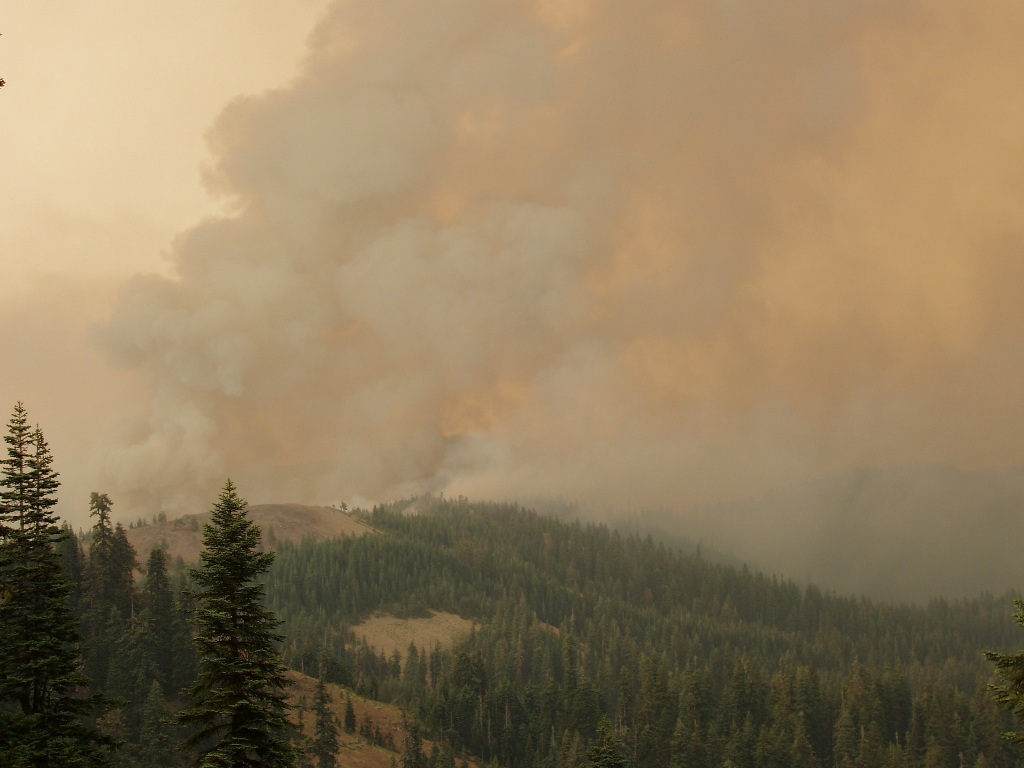
 [three hours into the burnout]
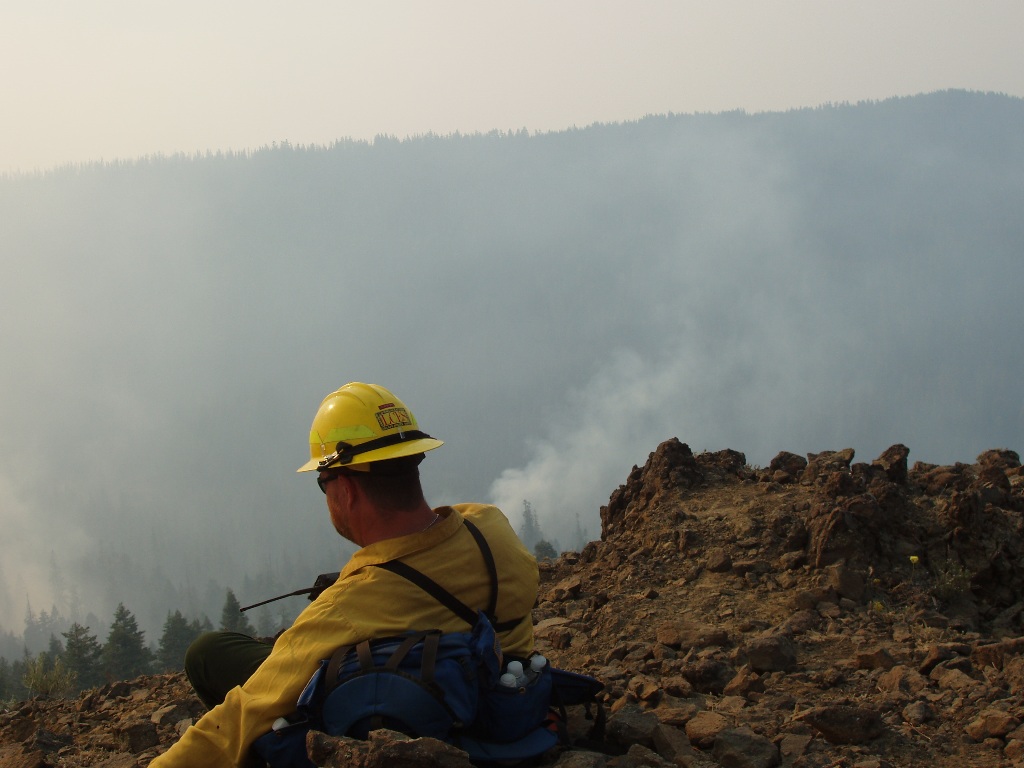
 Another day, I was posted at the “top of the world lookout” at about seven thousand feet, where I had a smoky view of Mt. Lassen and an incredible 360 view of the whole Cub complex. It was like having a front-row seat for a day as crews were moved around, trees torched, spots were discovered and put out. My partner that day was a more experienced medic who used to work on the fireline, and he was doing double-duty as a lookout for our division supervisor. It was quite the education.
 I got to know the faller team from my second day rather well, and ended up sharing several meals with them over the next two weeks. One day they took me with them as they cut down trees along the highway that the fire had closed down. They were looking for trees whose roots or lower trunks had burnt in such a way that they were likely to fall on the road, posing a major hazard to unwary cars. There’s nothing quite like having a massive fir tree fall straight towards where you are standing and explode as it hits the pavement a few feet away. My stomach was not the same for the rest of the day. (I know it is sideways … I can’t fix it.)
 [war paint]
 On the second-to-last day of my tenure on the Cub, my partner and I left the line late and ended up heading down the mountain on logging roads we hadn’t driven before. We were well behind the crews and well ahead of the division supervisors who were waiting for night-shift to arrive. That day, crews had lit a huge burn-out which was still flaming hard even in the cooler, damp night-weather. They wanted the arriving shift to know exactly what was going on. My partner and I took a wrong turn at an unlabeled T-intersection. A mile later, we came around a corner and found ourselves in the middle of the burn with no way to turn around. The road was narrow with steep banks on both sides, boulders loosed by the fire scattered across the gravel and flaming trees all around in the dark. It was surreal, as was the quickly rising temperature in the vehicle and the crackling I could hear through the closed windows. When we came to a flaming tree that had just fallen across the road, we made a quick decision to risk a 150-point-turn and high-tailed it back to our wrong turn.
 Thankfully, there were no major incidents or accidents on my fire. I saw a few decent burns and lacerations, and got more experience with the many and varied presentations of dehydration but for the most part the medical issues I saw were relegated to the blisters-and-sniffles I had been told to expect. When I got back to Alaska, I heard some wild stories about other medics who had some major trauma on their lines. As confidant as I am that I have the skills and perspective to deal with such eventualities, I’m just as glad my first fire was a mellow affair. It let me figure out how things work, what to expect and how to navigate the particular landscape of a long-term ICS operation.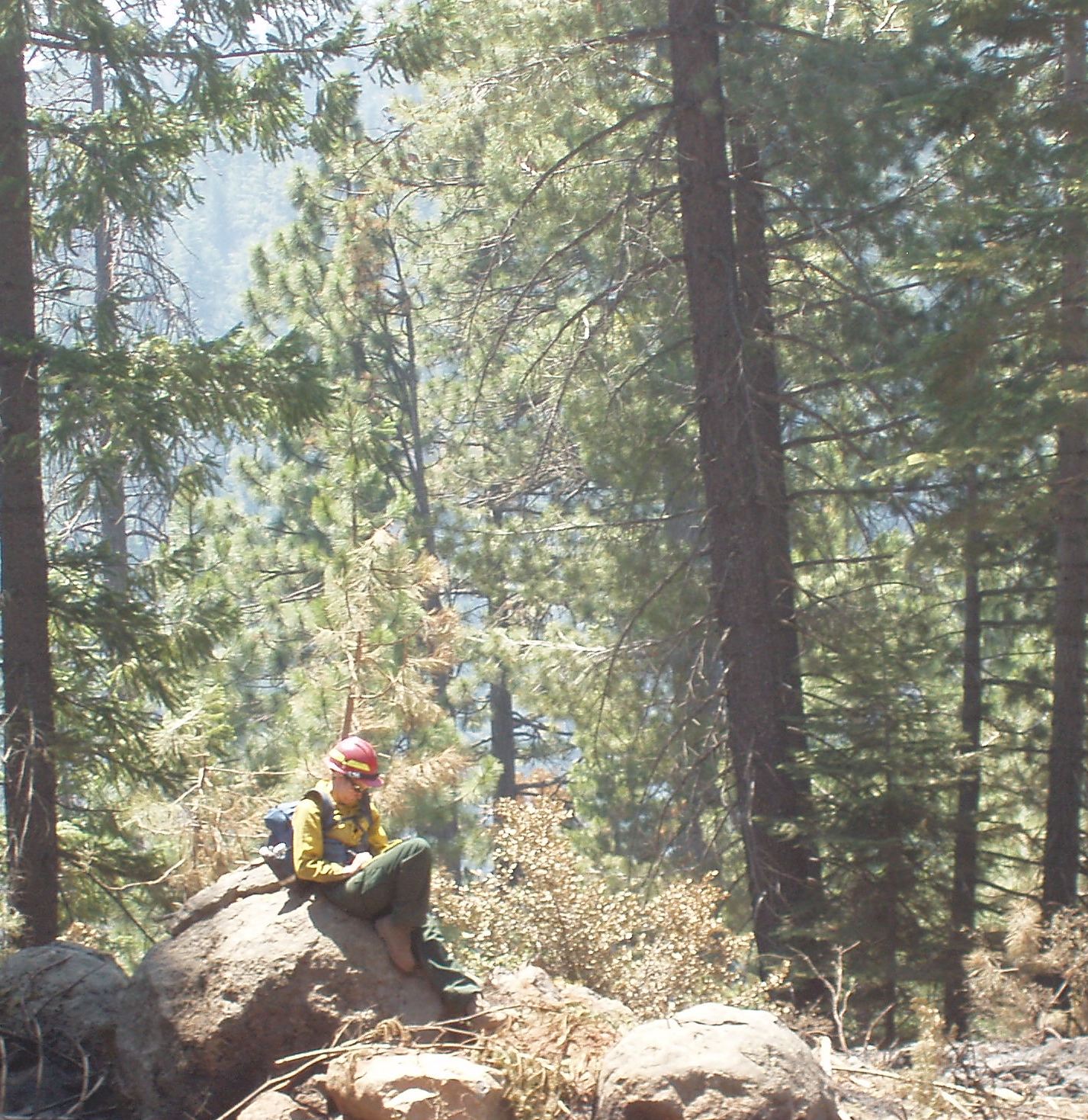


 entelechyproject