Category Archives: post bucket

eucallipterus

Overview of a failed weekend annihilation project.

Or: possibilities and limitations encountered through idle weekend google searches, in the Latin. 

  1. Get fed up with your street-parked cars being constantly covered in a sticky layer of sap.
  2. Google for an explaination for a while, before realizing you’ll need to identify the kind of tree growing in front of the house first.
  3. Recognize that you do not know enough about trees and leaves to even begin to narrow your foliage down using google.
  4. Download a leaf-identification app, then fail multiple times at taking a leaf-picture of sufficient quality for the app to recognize.
  5. Finally successfully identify the tree as an American Linden (Tilia americana).
  6. Use google to find out why cars may be covered in sticky goo if parked under an American Linden tree.
  7. Learn that there is a specific type of aphid (Eucallipterus tiliae) that infests American Linden trees.
  8. Further, that the aphids attach to the veins of leaves like ticks and let the tree sap run through their tiny bug guts, digesting a small percentage of the nutrients and letting the rest splatter all over any and every object below.
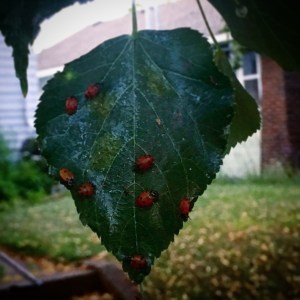
  9. Go outside and look at the leaves you can reach, find each leaf covered in dozens of aphids.
  10. Return to google, to discover that there is not much one can do for an aphid infestation of several full grown trees.
  11. Subsequently learn that ladybugs (Coccinella septempunctata) are actually voracious predators specifically evolved to decimate aphid populations.
  12. Learn that you can buy 1500 ladybugs through Amazon (not prime eligible) for $10.
  13. Order 1500 ladybugs.
  14. Receive a bag full of 1500 ladybugs.
  15. Release the approximately 1475 live ladybugs in the bag onto the unsuspecting aphid population at dusk, per the instructions in the box.
  16. Check the leaves the next evening, to discover that there are now only one or two aphids per leaf.
  17. Go out to the car the next morning, only to learn that it just takes one or two aphids per leaf to keep your car covered in sap.
  18. Purchase another three gallons of windshield washer fluid.

IMG_3556

1 Comment

Filed under post bucket

endogenous

An intensive care doctor shrugs as a young woman writhes in bed, fighting her breathing tube in a panic as sedation is weaned for extubation. “Well, that’s what she gets for overdosing.”

During a break in training, an instructor brags about her studied lack of compassion for the addicts she is assigned on the floor, “They do it to themselves,” she spits, “They made the choice to put that stuff in their bodies.”

“She’s non-compliant, and addicted to pain medication. What does she expect us to do for her?” sighs a nurse, reading over a re-admission chart while waiting for the patient to come up from emergency.

A triage tech mutters over her shoulder while struggling to get a blood pressure, “She wouldn’t be having a panic attack if she hadn’t smoked meth in the bathroom.”

Conversations this week echo an entrenched sentiment I have heard repeated in ambulances, emergency rooms, inpatient units, training centers and classrooms. Attributing personal fault to survivors of suicide attempts, addiction, unintentional overdose, or the sequela of mental health conditions of any stripe, the idea that people end up needing healthcare because of deliberate choices at all, gives an easy excuse to detach, disengage, and keep our own shoes on our feet.

I am no stranger to the dark humor that keeps those working on the front lines of emergency and critical care from cracking in the face of the onslaught of trauma and tragedy we witness every day. The humor is not only understandable, but necessary for the clinical detachment, emotional release, and camaraderie it can foster between those who share the strange drudgery of life-or-death medicine. I also appreciate the flares of anger, and where they land. It is easier to displace the flood of emotion at losing a child’s pulse for the last time in a trauma bay towards the rank homeless man with a curb-and-gravity induced head injury, trying to elope from the next room. We cope as we can, and none of us, least of all me, can throw the first stone for callous and judgmental flares in the face of the wash of humanity that we encounter shift after shift.

But some pronouncements of judgement, of declaring a human worthy or worthless of care, are different, somehow. I have spent a good deal of thought this week trying to piece together where and why some cross that line.

Many of the people I grew up around still believe, deep down, that illness is something you bring upon yourself. Do you have hypertension? It’s because you don’t exercise. Do you have diabetes? It’s because you eat junk. Do you have cancer? It’s because you didn’t wear sunscreen, or wore some kind of toxic sunscreen, or didn’t eat enough fiber. Sure breast cancer unfairly strikes down young mothers, but probably they were using deodorant with aluminum, or didn’t drink organic milk. Blame is easy to come by. My mother, for instance, still speaks often of how diabetics only have their poor lifestyle choices to blame, even though her thirty year old, healthy, physically active son-in-law with a BMI lower than hers has an unmedicated A1C hovering around eight and blood sugars in the 200s. These sentiments may not be openly admitted, but they are pervasive. This was reflected recently in an Ohio politician’s attempt to prevent ambulances from responding to chronic overdose victims; a three-strikes response policy. But these value judgements are the natural outgrowth of a society built on a bootstraps mentality, one that tolerates, even if it doesn’t openly embrace, a health-and-wealth gospel. Morality makes you healthy, not genetics, and certainly not chance. (Although when pressed, they may admit that moral, hard working ancestors passed on your healthy genetics, bringing this whole discussion uncomfortably into eugenics territory. But that is for another time.)

And this is where we get into trouble. If someone can still be blamed for diseases that can arise almost entirely from genetic predisposition or accident, how do we even start to talk about the biochemical realities of mental illness and chemical addiction that are less easy to quantify and graph and illustrate on network TV. If your hypertension is your own fault, how is your depression really ultimately due to anything but personal weakness. How is spending your paycheck on a cocaine bender after three months sober anything but your own deliberate choice? Not the fact that your synapses have physically been rewired such that your deepest primal instincts compel you go after the high as matter of survival. That your prefrontal cortex is literally starved of nutrients in those moments, effectively knocking out rational decision making capacity. Yet no one blames the patient with a tumor strangling his spinal column for a sudden inability to walk. These things still remain uncorrelated in our minds; even the minds of the people who should and do know better.

Neuroscience is slowly unlocking the physiological realities driving thought, mood and behavior, but there is a long way to go before even medical professionals with the research at their fingertips begin to accept the messy consequences of epigenetics as a physical reality and not a moral choice. The thing is that the level of detachment which goes beyond clinical necessity and begins to assign personal blame also makes allowances for a poorer quality of care. The health outcome statistics tell a damning story there, and the blame lies with us all.
1 Comment

Filed under post bucket

erodios

I didn’t start trying to find a companion until six o’clock on Friday night, so it was no surprise that I ended up paddling down the Mississippi alone early Saturday morning. The weather promised to cooperate, and I’d been wanting to try the new paddle-share stations since they opened up last summer. The water was flat calm, with just enough of a breeze to lick up the sweat gathering from paddling up-stream to warm up to the wide, short boat and get more time on the water. I got as far as the big highway crossing and let the current spin the boat back around, starting a more leisurely paddle towards the take-out near downtown Minneapolis.

The route is mostly scrubby shore-trees and abandoned mooring stations for an army of barges absent from this stretch of water now that the Saint Anthony Lock has been decommissioned. Behind the low trees, the cement stacks, cranes, and rusted catwalks of a vast industrial district along the I-94 corridor loom silent.

IMG_3493

Redwing crows drifted over the river, and a bald eagle or two lofted high above, disinterested in this particular stretch of water. A momma mallard and her eight teenage ducklings glided past, dipping for weed along the shore.

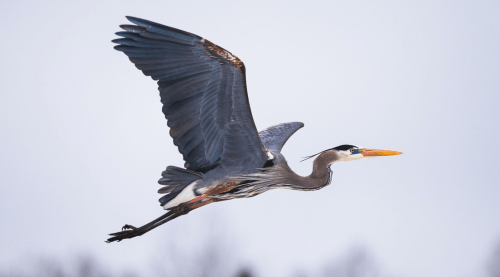
I saw the scooped wings of a great blue heron low on the river, pushing hard to gain height, then gliding across the water, sinuous neck tucked back, six foot wingspan casting a flitting shadow on the eddies near shore. She tipped back just before a huge dead tree, bleached white in the sun, and landed with a smooth curtsey on one of the top-most branches. The old skeleton stretched high above the greenery around it, and its branches held three, five, no, twelve other massive birds, basking in the warming morning sun, scanning the water for the shadows of fish on the riverbed. Now I let my eyes run along the shore, and found the huge driftwood trees, dried roots shooting up as high as branches, host to even more, some sleeping, some stretching, some striding through the shallows spearing small game among the ducks and smaller shore-birds. I let the boat drift closer to the rookery, but steered back into the main channel when graceful heads shot up and several of the birds winged out in protest at being approached. Content enough, I drifted on downstream, watching for them now, nearly invisible against the downed trees and rocky shoreline until they took flight and spread their great wings above the water. I couldn’t have asked for better company.

Screen Shot 2017-07-09 at 8.08.46 AM.png

Photo Credit: Laurent Silvani Photography (cc)

Leave a comment

Filed under post bucket

prognosis

The image is all blacks and whites and oscillations of grey, the skull an imperfect disc encasing a nebulous core. As the screen spins through slices, piling up from the winged atlas, a white mass blooms to the left, gaining ground, spreading tendrils into the grey. The pressure of its pale bulk shifts the center line. At the peak, the flickering images pause. The center of the treasonous cluster of cells has faded back into grey, darker and darker, a small puddle of shadow.

“It’s necrotic. It’s growing so fast, it’s eating itself from the inside.”

Leave a comment

Filed under post bucket

patriot

I was with my father on the eastern edge of the west Texas desert. We were spending the weekend in a friend’s cabin a few miles from where the shallow Llano river has carved her way through precambrian granite, leaving sparkling serrated cliff faces at every bend. I was home for a few weeks from college, a rough first year that I had somehow stumbled thorough intact, living in a haze of culture shock, turning inward more and more as the months passed. I had found some release in wandering the empty suburban streets on foot late into the night, and in trying to get a handle of what I was feeling by putting things down on paper. There was a lot of writing that year. Dire, anguished, inward gazing little poems littered my notebooks and filled folders on my desktop. They were terrible, but they gave substance to the turmoil I was trying hard to hide between dorm rooms and classes and weekend trips into Chicago.

I had brought scraps of these into the desert with us. I shared a few with my father at dusk the first night, sitting together on the low screened porch facing the sunset over scraggly mesquite trees and rock still shimmering with heat from the early summer day. They ones I chose were poems about alienation. I was proud of these few, I had worked on them, honed them down to a perfect image of what my year had been. A first away from family, but also away from a home I could never return to. They were about growing up in a blank space between cultures, about being thrust suddenly into a life where I didn’t know the nuance, or how to navigate the details, or what was expected. About never having developed the cultural memory that bound everyone around me though references and asides and knowing glances. About being surrounded by people who blindly pledged allegiance to the accidental geography of their birth, and had no patience for the hesitation I felt about their assertions of superiority, their flippant dismissal of things beyond their immediate horizons.

After a very long silence, he asked me, his voice pained in a way that still rings in my ears two decades later, “Why do you hate America so much?”

And I could not answer him. Because I did not hate America, despite my misgivings. I just didn’t love her the way I was expected to, after spending a long and rambling childhood carefully learning to love everywhere else.

1 Comment

Filed under post bucket